Anyone can run YOLO. Not everyone can build computer vision.
There's no shortage of agencies that can download a pretrained model, wrap MediaPipe in an interface, and call themselves computer vision experts. We engineer what has to work after the demo.
That's not engineering. That's a tutorial with an invoice.
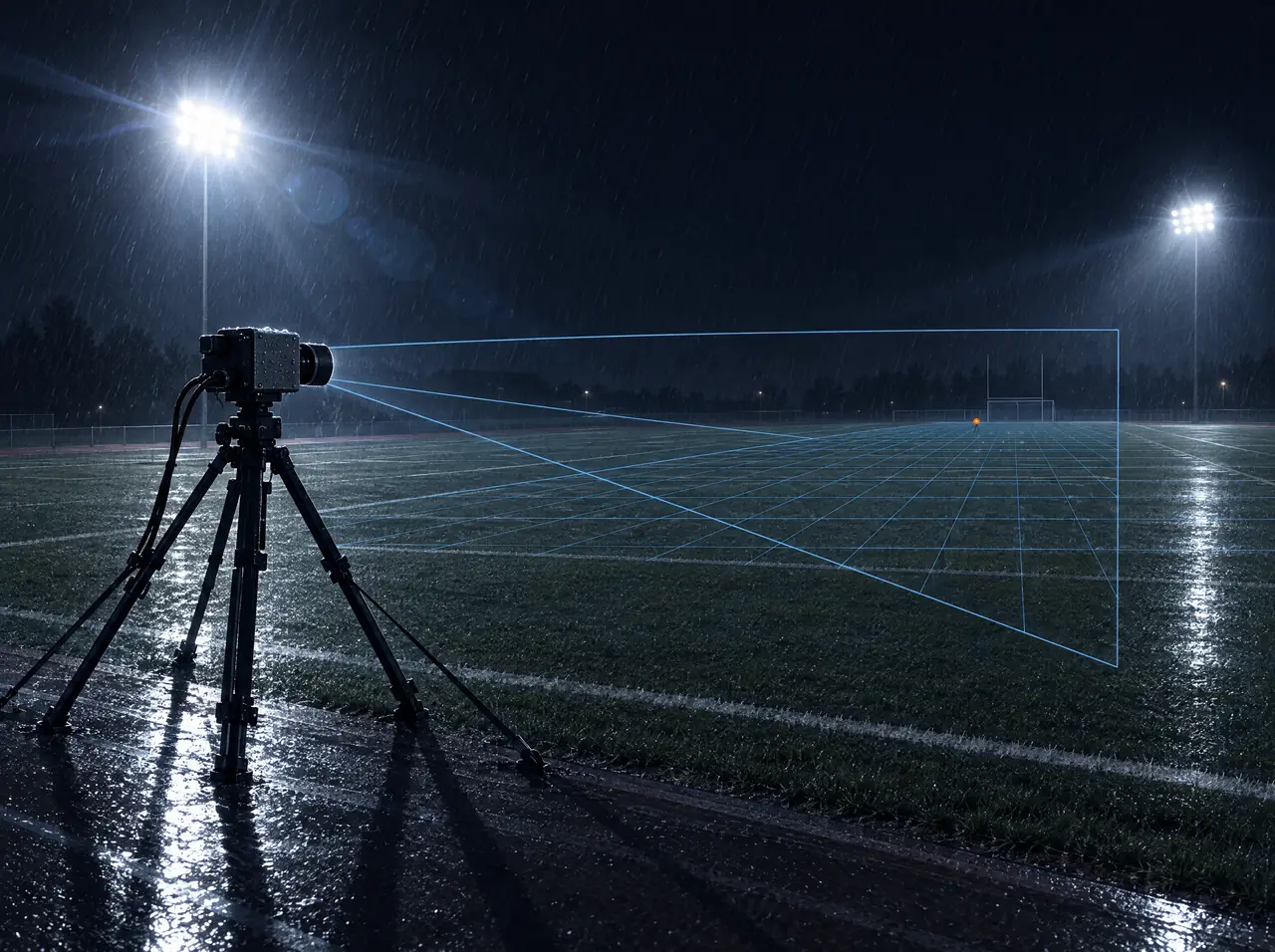
Real computer vision is hard. Bad lighting. Occlusion. Moving cameras. Unreliable measurements. Hardware limits.
Models that look incredible in a demo fall apart the moment they meet the real world. Those are the problems we engineer for, starting with how the system will be measured.
It works in the demo. Then the camera moves.
The demoWorks on the clips it was shown.
The systemMeasured on held-out footage from the real setting.
The demoA pretrained model with default thresholds.
The systemA model chosen, fine-tuned, or built for the task, with thresholds set from measured error.
The demoBoxes and skeletons drawn on screen.
The systemCalibrated measurements with a stated error.
The demoRuns on a developer's GPU.
The systemFits the target device's latency, memory, and power budget.
The demoFails quietly.
The systemFails visibly, with fallbacks and monitoring.
The demoLabeled once, then left alone.
The systemAn annotation and retraining loop that keeps improving it.
Research depth. Production discipline.
Computer vision systems engineered for real conditions: custom models, pose estimation, tracking, 3D reconstruction, camera geometry, and edge inference, evaluated before anything ships.
Custom models
Detection, segmentation, and keypoint models trained or fine-tuned for your task when a pretrained model misses the bar.
Pose estimation and biomechanics
Body and joint tracking turned into angles, timing, and movement measures, with the error stated.
3D reconstruction
Depth and 3D structure from one or more cameras, from calibrated multi-view rigs to single-camera estimates.
Detection and tracking
Objects and people followed across frames, through occlusion, crowding, and identity switches.
Camera geometry
Calibration, synchronization, and the projective math that turns pixels into positions in the real world.
Edge and mobile inference
Models compressed and tuned to hit a frame budget on phones, embedded boards, and edge GPUs.
Specialists who know why models fail. Not just how to call them.
Computer vision talent is scarce and hard to judge from a résumé. When a problem calls for specialist depth, we find, vet, and lead the researchers and engineers who understand the mathematics, the model architectures, and the production constraints behind it.
Define the measurement
What the system must see, how accurate it has to be, on which hardware, and the evaluation set that will prove it.
Build the data and the model
Collection, annotation pipelines, and held-out test footage from real conditions, then the model the task needs: off the shelf, fine-tuned, or custom.
Ship it and keep it honest
Deployment on the device or in the cloud within a latency budget, with fallbacks, monitoring, and retraining when the world drifts.
We're not competing to be the cheapest team that can make a demo work. We build the system that has to work after it.
Work you can inspect.
- Computer vision / sports technology
Movalytix
Motion analysis software for athletes and coaches, using computer vision and biomechanics modeling to analyze movement from video.
- Founder experience
Eliseo Robles
As CTO at NurivaTech AI, Eliseo's public work includes smartphone-based computer vision and biomechanics systems and model evaluation.
CTO role: NurivaTech / sportFXSelected details under NDA
Good questions. Clear answers.
Do you build custom models or use pretrained ones?
Both. A pretrained model is the right start when it meets the error you can accept on footage like yours. When it does not, we fine-tune it or build a model for the task, and a held-out evaluation set decides.
Can you fix a computer vision prototype that fails in the field?
We start by measuring it on footage from the real setting to find where and why it fails. Then we decide whether it needs new data, a different model, a pipeline change, or a rebuild.
Can computer vision run on phones or edge devices?
Often. We design for the target device's memory, heat, power, and time per frame from the start, and we test on that hardware rather than on a development GPU.
How do you measure whether a vision system works?
Against a held-out evaluation set that matches the field, with error reported in the units the decision depends on, such as degrees, centimeters, or missed detections, rather than one headline accuracy score.
What do you need from us to start?
Footage or images from the real setting, the decision the system has to support, the error you can accept, and the hardware it must run on. We scope a bounded first phase from there, inside a Product Engineering engagement.
We don't sell computer vision demos. We engineer computer vision systems.
Bring us the hard problem: the camera, the conditions, the data you have, and the decision the system has to support. Product Engineering engagements start at $15,000, with scope agreed first.